Reclaiming the Pen When Your Hands are Shaking: Taking Authorship of Your Life Requires Feeling Safe

I was introduced to existential philosophy when I was fifteen years old, long before I first sat in the clinician’s chair. As an integral part of how I color my perception of the human condition and the world, it naturally bleeds into my therapeutic work with clients. Existential therapy has a rich history in clinical practice, notably through the work of Viktor Frankl, Rollo May, and–my personal favorite–Irvin Yalom. Unlike traditional psychotherapy, existential therapy does not rely on a structured framework but rather functions as a way of existing in the therapeutic process, focusing on parts of the human condition we all grapple with such as meaning, death, isolation, and freedom. My post today focuses on freedom, personal responsibility, and how trauma impacts our ability to access them authentically.
When we talk about “freedom” through an existential lens, we don’t mean unbridled independence without consequence. Human freedom is the capacity to choose one’s attitude in any given circumstance, as Frankl observed through his experiences as a Holocaust survivor. Yalom built on this with the idea of “authorship,” or the realization that we are the authors of our own stories. Existentialist philosopher Jean-Paul Sartre went so far as to argue that we are "condemned to be free," leaving us like Camus's Sisyphus, rolling our boulder in perpetuity. We carry the boulder-sized burden of freedom through personal responsibility. We hold the pen.
But what if our hands are shaking?
In my role as a trauma therapist, I am acutely aware that this idea can sound dangerously close to invalidating and victim-blaming. When a survivor hears "personal responsibility," a protective wall flies up, and without safety, it feels like judgment or an assumption that they somehow chose their pain.
That reaction makes complete sense when you look at how our brains are wired. Psychiatrist and neuroscientist Bruce Perry’s Neurosequential Model suggests that the brain processes everything from the bottom up (starting in our lower survival centers before reaching our higher, “rational” mind). A helpful way to picture this is Dr. Dan Siegel’s Hand Model of the Brain:
If you make a fist with your thumb tucked inside your fingers, your palm represents the lower survival brain, and your folded fingers represent your rational, thinking brain. When danger–actual or perceived–gets detected, those fingers snap open—we essentially "flip our lid." Your survival brain takes over instantly, temporarily putting that rational, thinking part of the brain offline so your body can focus entirely on keeping you safe.
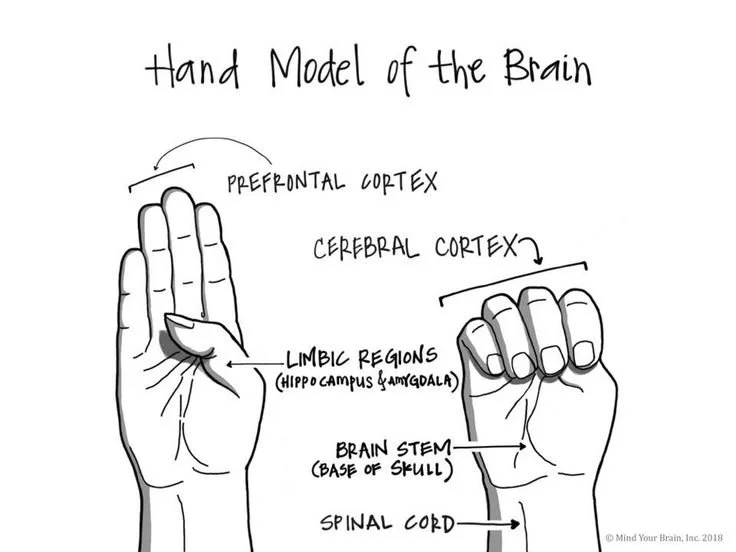
This threat detection isn’t faulty wiring! It is an evolutionary survival mechanism. Parts of the brain sensitized by past trauma are simply doing their job to keep you alive, even long after the threat has passed. To access true authorship of our lives, top-down cognitive reflection requires bottom-up physiological safety: calming nervous system arousal and grounding our bodies before asking the brain to analyze or reframe.
A big piece of safety is the physiological discernment of actual versus perceived threat, coupled with active nervous system regulation within our window of tolerance. Helping reduce the sensitivity of those internal fire alarms is important trauma-informed scaffolding that unlocks the deepest value of existential work. The path to autonomy is never simple when someone has been betrayed, gaslit, shamed, or abused. Traditional existentialism asks us to choose our attitude, but we cannot expect someone to deliberate over choice while their body is actively bracing for impact. By building somatic safety first, we separate past fault from present ownership: what happened to you was not your fault, but tending to your healing becomes a right you can step into as your capacity restores.
Reclaiming the pen isn't about getting your hands to stop shaking through sheer force of will. It starts by honoring why they are shaking in the first place and creating enough safety so that, slowly, the grip can steady.
Regulation restores the neurobiological capacity to respond to the present rather than react from the past–to authentically take authorship. Stepping into that authorship is not an ultimatum you must immediately meet, but a quiet reclamation of your right as a human being, waiting for you whenever your body feels grounded enough to write what comes next.
Selected Reading & Influences
On Existential Freedom, Agency, & Authorship
Viktor E. Frankl – Man’s Search for Meaning
Irvin D. Yalom – Existential Psychotherapy
Rollo May – Freedom and Destiny
On Nervous System Safety & Somatic Regulation
Dr. Bruce D. Perry – The Boy Who Was Raised as a Dog
Dr. Dan Siegel – Mindsight: The New Science of Personal Transformation & The Developing Mind
This post was written by Zoe Van Kirk, LCMHCA. Grounded in compassion, collaboration, and a deep curiosity about each client's unique story, they provide tailored trauma therapy and counseling services in Charlotte, NC. Discover how she can support you, or book an in-person session at Grey Embraced.